
Intake questionnaire by QR or email
Your front desk emails it or shows a QR code to scan in the waiting room. The patient answers from their phone, with autosave, and every specialty asks its own questions.
An HbA1c of 9.1 % drawn 143 days ago, with no follow-up booked. Whether it sits in a paper chart or in the software you already run, nobody flags it. Here it is a row with a name, a value, and days since.
Thyroid and lipid panel
The two labs that drive control, side by side.
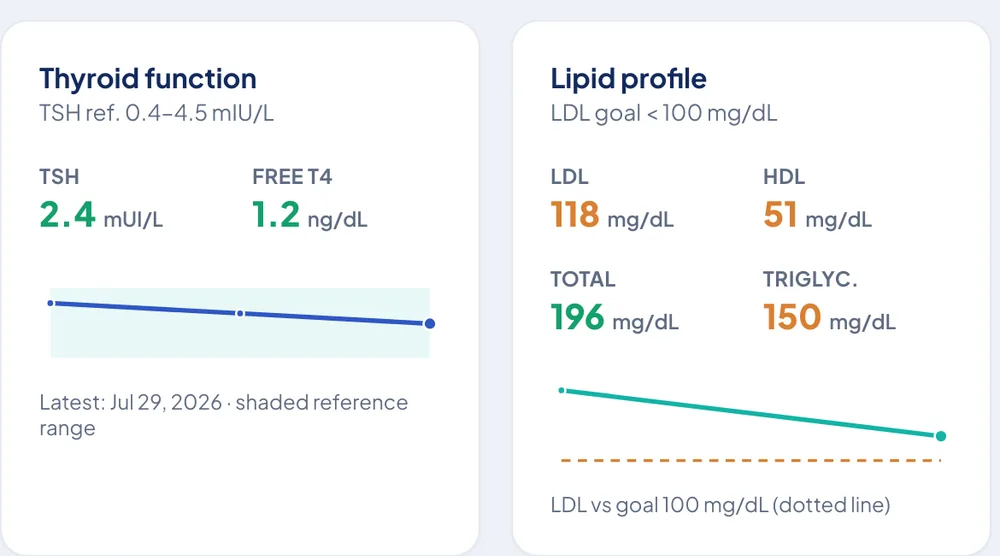
Every lab arrives with its reference range and its goal beside it: the value reads already interpreted, with no need to look the range up elsewhere.
Treatment goals and labs
What comes up when you open the chart, without asking for it or running a report.
HbA1c
Reference: Goal under 7 %
Value: 9.1 %
What the system reads: Off target
Fasting glucose
Reference: Goal 80–130 mg/dL
Value: 192 mg/dL
What the system reads: Off target
BMI
Reference: Goal 18.5–24.9
Value: 32.4 kg/m²
What the system reads: Off target
Blood pressure
Reference: Goal under 130/85
Value: 138/86 mmHg
What the system reads: Close
TSH
Reference: Reference 0.4–4.5 mIU/L
Value: 3.1 mIU/L
What the system reads: In range
eGFR
Reference: CKD-EPI 2021, no race variable
Value: 78 mL/min/1.73 m²
What the system reads: Stage G2
The first four are the goals the system tracks on its own; TSH is read against its reference and eGFR against its stage. eGFR is never typed in — it is derived from creatinine.
On the left, what happens in your practice today. On the right, what the system does about it.
What hurts
You eyeball March’s HbA1c against June’s with the patient sitting in front of you
What Medi Control Pro does
Both live on the same timeline, over the target band, with 7 % drawn as a dotted line. Nothing to compute: you just read it.
What hurts
You ordered the HbA1c months ago and never found out whether it was drawn
What Medi Control Pro does
Every study you order lands in a queue with three trays — arrived, waiting, overdue — and the days each one has been sitting there. The home screen tells you, with the name and the value, before you open anything.
What hurts
Your hypothyroid patient comes back when she remembers, not when she is due
What Medi Control Pro does
The system watches TSH against its 0.4–4.5 mIU/L reference and flags it when it goes stale or out of range, with the value and the days. Thyroid ultrasound already ships among the pack’s studies.
What hurts
You have no idea how many patients in your practice you have lost track of
What Medi Control Pro does
Six reports built into your pack: overdue HbA1c, patients with diabetes, thyroid follow-up, weight/BMI trajectory, BMI, and pending labs. They are recall lists, not reports to file away.
«The status colour uses the abnormality flag and the reference ranges sent by the issuing lab; they are not recalculated with generic ranges.»
The colour of each result comes from the lab that signed it, not from a generic range: what you read is what that lab flagged as abnormal.
The “overdue HbA1c” report
Your practice sorted by who slipped away, in two clicks and with CSV export.
2 patients above 8.5 % with no next visit booked, out of a list of twelve. Run the numbers on yours.
| Patient | Last HbA1c | Date | Days since | Next visit |
|---|---|---|---|---|
| Camilo N. | 9.1 % | Mar 12, 2026 | 143 | Not booked |
| Lucia G. | 8.6 % | Apr 1, 2026 | 123 | Not booked |
Two people at 9 and 8.6 who have gone four months without a review and without a next visit: on paper, or in a loose calendar, you never see that.
It does not ask you to change how you practice. It steps only into the moments where you lose time, or lose a number.
They answer the metabolic questionnaire from home: what they were diagnosed with and in what year, whether they check glucose with a meter or a sensor, whether they get low-sugar episodes, and how their weight moved over the past year.
Weight, BMI, waist, HbA1c, fasting glucose, TSH/T4, and lipid panel, each with its date and its arrow against the previous reading. Above them, your pack’s alerts sit next to the allergies.
The metabolic trend opens inside the note. The weight, BMI, waist, and glucose you take in the room join the series straight from the quick panel; creatinine and the albumin-to-creatinine ratio arrive as lab results.
The note becomes immutable and the next review is written into its plan: the calendar opens with that visit already proposed, and two days out the reminder to the patient goes out on its own, by email. No more notebook of who needed booking again. The visit charge moves through to billing.
The notices come up on screen on their own, with the source and the criteria behind each number.
On the monofilament it puts it in these words: the “2 of 3” rule belongs to the guideline; the person’s threshold does not. And it adds that the threshold it classifies a patient by was the product’s choice, not the IWGDF’s.
On the WIfI threatened-limb classification: without all three grades there is no classification, because filling in zeros would imply a healthy foot. Three independent grades, no sum and no total.
Lab color coding honors the issuing laboratory’s ranges. And where the source publishes no cut-off, the product leaves the scale without bands rather than inventing them.
Nothing to configure before you start seeing patients: your specialty’s lab orders, imaging studies, appointment types, and note sections are already in place.
All of it is editable: it is your starting point, not a straitjacket.
Patients book their visit, confirm it, and arrive with the questionnaire answered. You get minutes back on every visit, and your front desk gets calls off its plate.
Your front desk emails it or shows a QR code to scan in the waiting room. The patient answers from their phone, with autosave, and every specialty asks its own questions.
Photo, bio, price, and calendar on a page of your own, and it starts switched off: nobody sees it until you publish it. Patients see only real openings — availability minus booked visits — and pick one from their phone.
They sign in with their email and a one-time code — no password to create or remember — and see their upcoming and past visits, and request another with their details already filled in.
Dictate the note instead of typing it. And we tell you the audio may travel to your browser vendor's servers.
In your specialty, the questionnaire asks
Before the visit the patient reports what they were diagnosed with — type 1 or type 2 diabetes, prediabetes, hypothyroidism, hyperthyroidism, obesity — and in what year, whether they check glucose at home with a meter or a continuous sensor, whether they get low-sugar episodes, how their weight changed over the last year, what their parents and siblings have, their diet, and their physical activity.
Signed is signed: the original is never altered.
One clinic's data never mixes with another's.
It drafts, summarizes, and organizes. It never signs, diagnoses, or prescribes on its own.
Every action is recorded with its author and date.
A free plan that stays free, and room to grow into a multi-location clinic without switching systems. We set it up and hand it over running.
Prices, limits and terms are the same for all 11 specialties. What changes for Endocrinology is its clinical tool — Metabolic trends — included in any plan that enables the Endocrinology pack.
We turn it on for you with the full Advanced plan, 14 days and no credit card. You write to us, we agree on the plan, and we hand it over running. If you don't continue, you move to the Free plan without losing your data.
A practice just getting started
USD 0
free forever
no credit card required
One professional and their front desk
USD 29
per professional / month
or USD 23 /mo billed annually
Clinics with a team, up to 2 locations
USD 59
per professional / month
or USD 47 /mo billed annually
Multi-location clinic, up to 4 locations
USD 99
per professional / month
or USD 79 /mo billed annually
All eleven specialties are available on every paid plan: the number on each card is how many you can keep active at once.
Straight answers, no hedging.
The patient who comes back in three months, their trend against the goal, the thyroid on track, the foot checked, and a reconciled drawer at close. Bring us the case that keeps slipping and we will show you where the system catches it.